
OTT in Pakistan is dying, a slow and loud death
The audience numbers are disappointing, its nature is rented and a new entrant threatens disruption with more of the same. The OTT business will pay for the next tournament, runs its usual rent-a-viewer announcement and try to run the business on advertiser money.

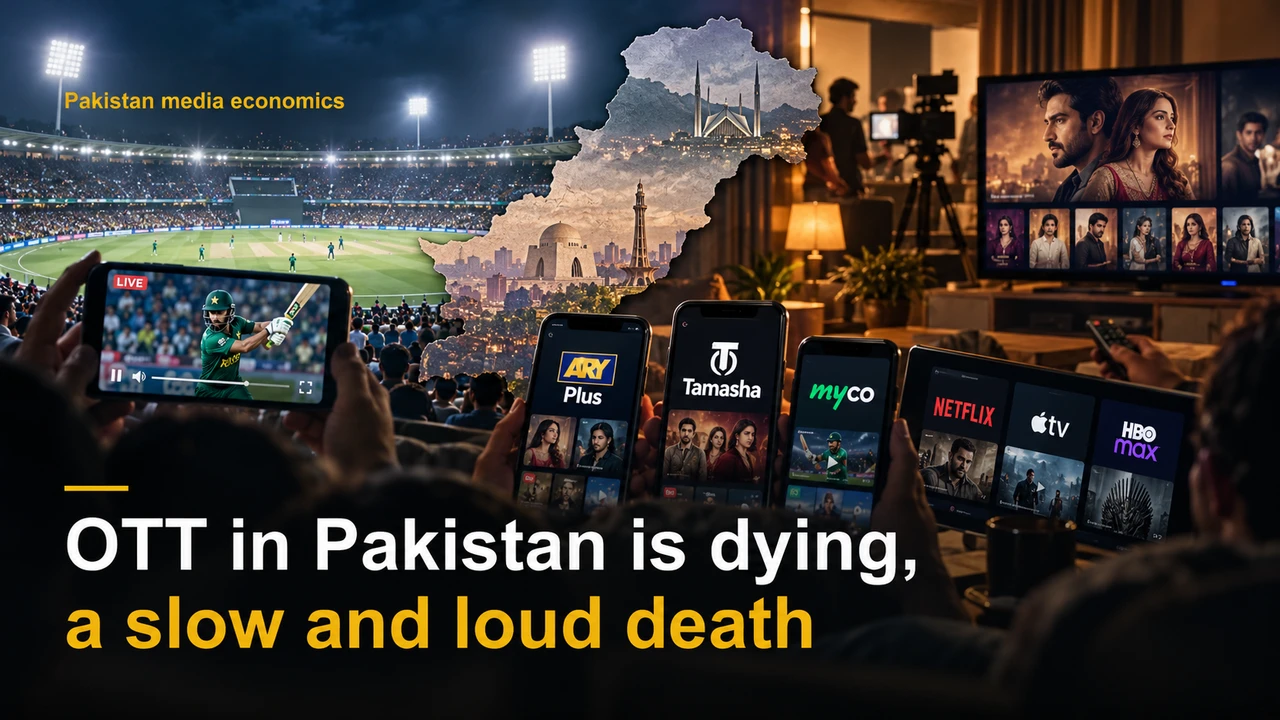
- The PCB announced a PKR 26.11 billion winning offer for domestic PSL television and live-streaming rights from 2026 to 2029. The audience comes with a substantial recurring bill.
- Myco's PSL business includes exclusive TV sales and monetisation, alongside non-exclusive OTT rights. An app's viewing number describes only part of that business.
- Tamasha disclosed USD 4.5 million of advertising revenue in Q2 2024. Jazz also earns from connectivity, giving it a different reason to keep people watching.
- ARY owns a drama library and a continuing programme schedule. Its opportunity is to build a viewing business around those assets, instead of joining another race to rent cricket audiences.
Pakistan’s OTT platforms keep presenting access to an audience as evidence that they have built a streaming business. ARY Plus is trying to move an existing drama audiences from Youtube into its own app. Tamasha and Myco buy cricket to keep viewers coming back to keep their investor-facing growth story alive. The industry’s success story depends on an audience rental and examples of Netflix subscriptions only go so far when most consumption still happens on premium Cricket content run free with ads. Will ARY Plus be able to make the difference? Or will it be unable to convert online viewing into subscriptions or ad revenues to for a durable business. With Myco branching out into devops, agency and commerce businesses, and Tamasha likely to follow into oblivion, and new global players entering (Apple TV, HBO Max) the future of OTT in Pakistan may be bleak.
The price is rising faster than the industry's explanation of the business
The PCB announced a PKR 26.11 billion winning offer for domestic PSL television and live-streaming rights from 2026 to 2029. Spread evenly over four years, that is about PKR 6.53 billion a year for the combined package, plus applicable taxation. Money has to travel back through that rights chain and pay back the investment and then some. Sadly, in the case of OTT in Pakistan, the maths so far is not mathing.
The distinction between the whole package and an individual app matters. A cricket match can be sold through television, several streaming services, advertising and subscriptions. Counting every outlet's audience makes the distribution look much bigger. I should know, I ran it for 2 years. In 2025, I put together the biggest ever audience footprint for the livestream of PSL 10. We brought together Myco, Tamasha, Daraz and the benign Begin to boast over 70m total viewers.
If several sellers take the same cricket match to a bank or a soft-drink company, they are competing for a share of that brand's plan. The buyer can compare the audiences, delivery and price. A rights holder has already committed to the attraction. The advertiser can still decide which outlet earns its money. That is an uncomfortable position from which to promise another year of growth.
Myco is selling less OTT and more of everything else
Myco's own announcements describe two different PSL businesses. It became the exclusive television sales and monetisation partner for PSL 11, with Geo Super, PTV Sports and Ten Sports in the broadcast arrangement. It then acquired non-exclusive OTT rights, offered through both paid ad-free viewing and free viewing with ads.
That makes the company part of television's advertising sales chain as well as an operator trying to build an app. A TV sales commission, an OTT advertising order and a consumer subscription come from different customers. Myco brought on amazing sales teams and has built more of an alternate sales operation than an OTT.
The other worrying thing about Myco is that its announcements about investments are quite circular. One minute, they talk about having won investment from Draper, the next week an announcement say an equal amount was paid to Draper to buy the Draper show. One minute they have bought BDigital for PKR 1 billion, the next day we hear that BDigital has invested an equal amount into Myco. And then there's the heavy divestment of people and resources from the OTT into what can be called side hustles. There is now a devops and tech services business, a marketing and media agency, a news AI and sports all happening at the same time. Is that the method? Or is that a sign of the bills racking up and impending fate of OTT weighing heavy on the company?
Tamasha is trying to survive on somebody else's cricket business
Q2 2024 earnings call of VEON said Tamasha earnt USD 4.5 million in the cricketing quarter that passed. 2 years later, that number hass stagnated (if not contracted) and it cannot explain Tamasha's position in October 2026. The industry has changed around it. Treating that quarter as evidence that the business has found its footing ignores who now controls the cricket and who gets to sell it.
In May 2024, Jazz announced Tamasha's acquisition of streaming rights for the major ICC tournaments through 2025. For the next cycle, the ICC named Myco as its digital rights holder, with Tamasha, Tapmad and ARY Zap among the distributing platforms. Myco's own managing director describes the ICC arrangement as one in which the other platforms sub-license through Myco. He also identifies ACC and PCB cricket as directly licensed to Tamasha. These are different tournament contracts, but the ICC change puts a competing app above Tamasha in that supply chain.
That is a problem when the two apps then take substantially the same attraction to substantially the same advertisers. Bringing more viewers into the arrangement can make the combined offer easier to sell to advertisers. It also means Tamasha's audience can strengthen a package whose commercial control aggregates into Myco. Tamasha remains one of the top searched OTT's in Pakistan but fails at being able to monetize it beyond its own spending.
VEON should be looking to pullback investment after almost 5 years of costs into infra and media acquisitions. Tamasha is being pushed to hunt for revenue while its cricket advertising is sold through rights holders and its return being a nominal share of a common pool. Selling more of that pool does not give Tamasha control over the sale, the price or the customer. It leaves the platform carrying an audience operation while relying on a competitor to turn it into money.
Tamasha does carry entertainment beyond cricket. VEON's Q2 2026 filing names agreements for Green Entertainment and Aur Network's VOD libraries. And that helps a lot. But not enough. Last available filings report 48.9 million quarterly active users in Q1 and 38.7 million in Q2, describing the 20%+ reduction as a "usual cycle" when sporting activity falls. 10.2 million fewer users is not a loss an opco should consider 'usual' or 'ordinary'. This seasonality runs for most of the year. Key cricket tournaments are only 2 months of the year. For a sustainable operation, much more should drive audiences to the platform. For the operator, it means the additional content has not removed the dependence on the sporting calendar.
Tamasha Pro subscription offers are sold mostly through Jazz' own internal promotions as opposed to consumers seeking them out. A viewer buying access to a particular tournament still has a reason to move when another app offers is cheaper or better. The competition in the space is untenable and is being driven to a zero sum game by rising cricket rights pricing.
Selling more ad formats does not fix who owns the demand
To its credit, Jazz Digital has tried to sell beyond the match. Its MaxReach announcement combines Tamasha and Simosa inventory, offering mastheads, home banners and first-scroll ads against a claimed audience of more than 30 million monthly active users. While I welcome the approach, the 30 million does not reconcile with the announcements from Tamasha who said its lowest MAU was 38m+ - then the only question to ask is how did Simosa achieve a negative 8 million in MAUs? The maths is not mathing, again!
Plus, those formats compete for a brand's digital budget on delivery and price. They do not give a brand a reason to fund Tamasha's next sports rights purchase. If the reason people open the app remains a match they can also watch elsewhere, adding another banner position cannot create the pricing power the rights bill demands.
ARY owns the content, but it can still destroy the economics
ARY starts with an advantage Tamasha cannot buy. Salman Iqbal's ARY Plus proposition adds exclusive programming, network channels and a proposed creator-upload and royalty system. It has a large library going back decades to build around before it goes shopping for cricket.
Moving those programmes off YouTube still has a cost. A heavy one that I think ARY is already starting to notice. The last known revenue for ARY from Youtube was well over USD 1 million per month, that is atleast USD 12 million a year. And now, ARY is taking over distribution, discovery, playback, billing and advertiser access from a service that already does those jobs at enormous scale. Owning more of the transaction only helps if the audience follows and the extra revenue exceeds the extra work. An installed app is not compensation for losing a viewer who used to watch every episode.
ARY has to sell the additional value of the viewing relationship. Otherwise its own TV sales compete to collect money from the same buyer for the same content. Or it can add an app's costs to a television business while making its content harder to reach. The launch announcement seems conflicted in and of itself. On one hand, it says it will wean off Youtube, and on the other, it does not seem to have a commercial strategy tuned to how digital works.
Pakistan's OTT industry is accumulating obligations faster than it is building control over what pays them. Myco is expanding into the businesses that have nothing to do with streaming. Tamasha is clearly aloof to how the media world works. And, ARY is taking on the distribution work without having considered how to make money from it. With 150m+ digital penetration, Pakistan was ripe for OTT. But it seems now like the beginning of the end for OTT in Pakistan.
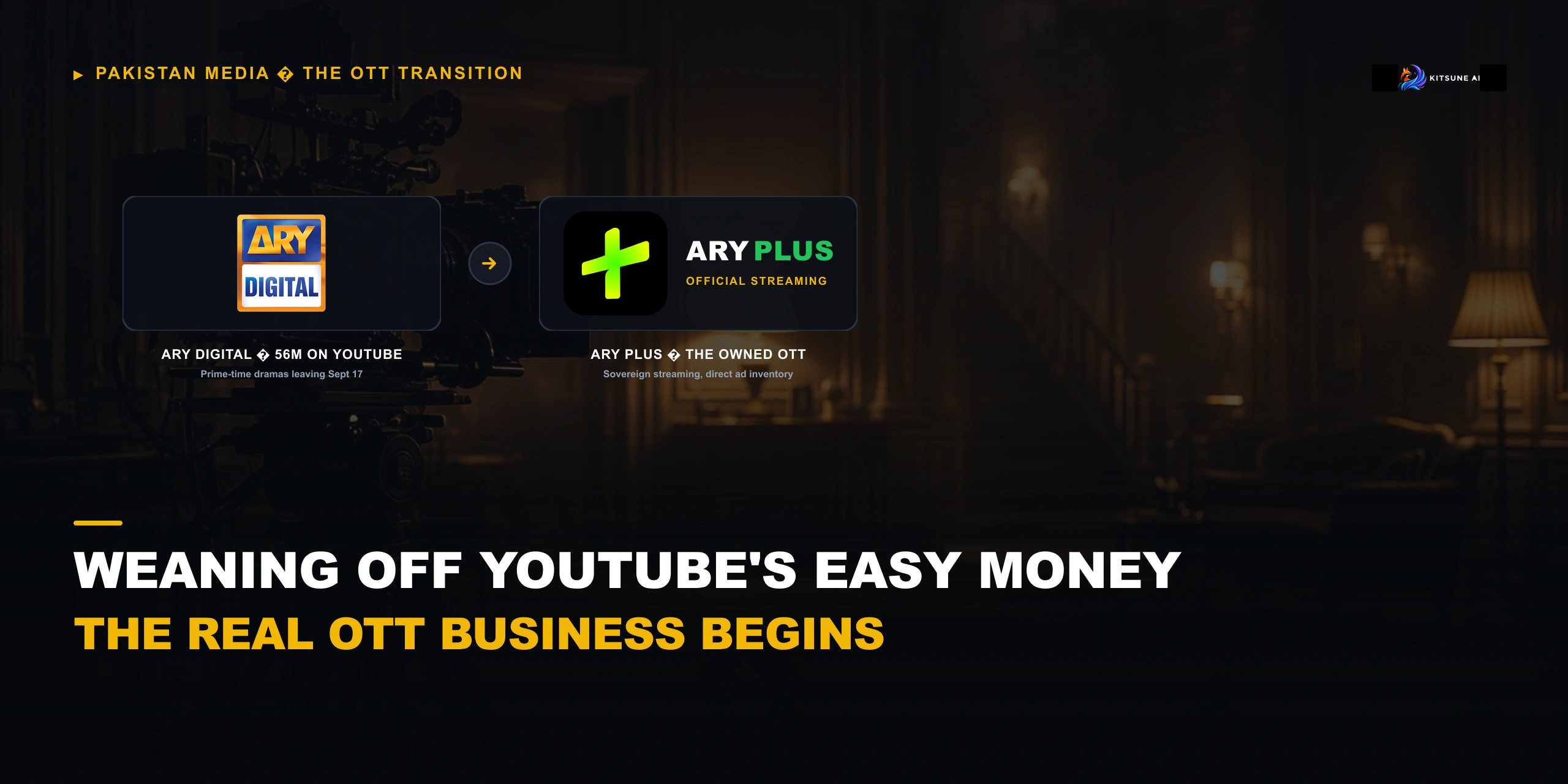
ARY Just Pulled Its Dramas Off YouTube. Now Comes the Streaming Bill.
ARY Digital announced it will remove its prime-time dramas from YouTube on September 17 to make them exclusive to ARY Pl
Read article
How YouTube makes money in Pakistan, and who gets paid
With ARY Plus launch, the biggest content category on Youtube is under pressure. Cricket feeds from Pakistan travel thro
Read article
Cannes is back to being the gatekeeper of creatives
DM9 faked CNN Brasil footage in a case film and Cannes took back 12 awards. It was right to. Then came the integrity han
Read article
The math isn't mathing for global sports streams. NBA talks with Youtube called out as a fire sale.
Tech blogs are calling the NBA talks with YouTube a streaming revolution. It is a bankruptcy fire sale. Cable subsidized
Read article