
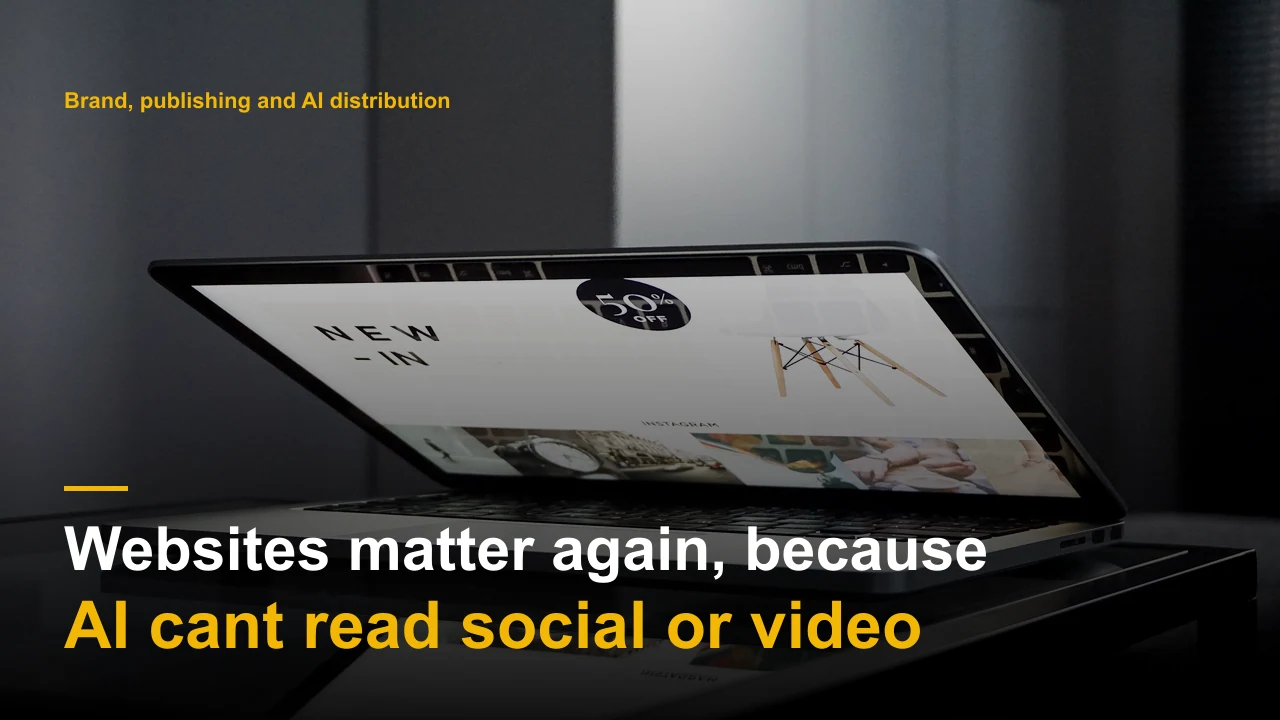
Websites matter again, because AI cant read social or video
Brands spent years moving the customer relationship into somebody else’s feed. AI is giving the website a job again, and a prettier homepage will not be enough.

- Consumers are turning to AI in droves. And most AI tools can not find your brand online.
- AI discovery is still happening around retail catalogues. Brands have laid waste to their owned presence by focusing too much on video and social.
- Most major brands still carry a short description page, mostly outdated. Worse yet, most have a robots.txt that tells AI tools not to read them.
- Your site has to help people trust you, your partners and understand your brand. And Astro is becoming a favorite for AI-friendly sites.
- Marketing teams need to start reorienting themselves as over 52% consumers will turn to AI for answers, first.
For years, the website kept losing arguments inside marketing departments. The campaign was on Instagram, Youtube and more recently Tiktok. The product demonstration was on YouTube. The enquiry arrived on WhatsApp. A marketplace handled the order. Somebody still renewed the domain, but the budget and attention went to the places where the customer appeared to be spending time.
Now the customer is asking an AI assistant which business to consider. The answer needs something more useful than the collection of posts we have been paying to distribute.
A video of a sofa can make somebody want it. It does not necessarily tell them which sizes are available today, what the fabric options cost, whether it fits through an apartment doorway or what happens if the delivery arrives damaged. A campaign caption disappears beneath the next campaign. The seller still has to answer those questions when a buyer is ready to spend.
That is the website’s way back into the conversation. The brand needs a place where its offer is complete, current and recognisably its own. AI makes the cost of leaving that place neglected much harder to ignore.
The transaction still belongs to somebody
Look at what the commerce companies are actually building. In March, Shopify opened its merchants to AI shopping channels, including ChatGPT, Copilot and Google’s AI experiences. The product information comes from the merchant’s catalogue. Pricing and checkout customisations carry through, and the merchant keeps responsibility for the transaction and the customer relationship.
OpenAI’s product-discovery announcement makes a similar distinction in practice. ChatGPT helps the shopper compare products. The merchant’s online store can complete the purchase inside an in-app browser. The route to the shop has changed, while the shop still has work to do.
This is a much more useful signal than another claim that an AI interface will make every website disappear. Someone has to maintain the product record, take payment, deliver the order, handle the complaint and decide what the business is willing to promise.
If a retailer gives its products three different names across its social account, marketplace listing and own store, the problem starts inside the business. An AI assistant cannot resolve an argument the retailer has never settled. It will find a different seller with a clearer offer, or give the customer an incomplete answer.
The marketing implication is fairly direct. Keeping product information accurate has become part of distribution. It deserves the same operational attention as the campaign that creates demand for it.
A catalogue gets you considered. The brand still has to earn the order
It is tempting to turn this into another technical brief and hand it to the website vendor. Add some fields, fix the feed, publish a batch of answers and declare the business ready for AI.
That leaves out the part marketers are supposed to understand.
When the assistant offers three options, the buyer still has a reason to choose one. They may care about the material, service, delivery promise, previous work or the people responsible. A cheap-looking site with vague claims can undo the confidence created by a good recommendation. A beautiful site that conceals basic information can do the same.
Consider a business choosing an engineering partner. It needs to know what the team has built, what the company will own after the work, how implementation happens and who answers when something breaks. A founder’s video can establish personality. A case study can establish the circumstances, work and result. The site should connect them, so the buyer can follow an argument about why this company is worth hiring.
That is editorial work, commercial work and design work. The team has to make the offer intelligible, show evidence and make the next decision easy. A page full of interchangeable claims about transformation does very little of that.
The website needs enough substance for an assistant to describe the business accurately and enough character for a person to remember why they wanted it.
Visits are becoming an incomplete way to value the site
There is an obvious objection. If AI answers the question without sending the person to the website, why spend more on the website?
Because the information can influence the decision before the visit happens. Marketing has dealt with that problem before. People do not buy only at the point where the tracking system can see them.
Pew Research Center’s study of US browsing behaviour found that traditional result links were clicked on 8% of visits to search pages with an AI summary, compared with 15% without one. That is a reason to rethink what a visit count tells us. The material on a company’s site may help somebody form a shortlist even when that session produces no referral.
I would still expect the website to earn its money. I would look at the quality of enquiries, what customers already understand when they arrive, whether the offer is being represented accurately and whether people can complete the purchase. A site that receives fewer casual visits and produces better prepared buyers can be doing a more valuable job.
This also changes the internal conversation about maintenance. The old campaign microsite could be left behind when the media budget moved on. A business record used in ongoing discovery needs someone to keep it right. Products change. Teams change. The work the company can prove changes. The website cannot remain a photograph of the business from the last redesign.
The website has to earn the buyer’s confidence
Google’s own guidance for AI search features puts accessible, useful site content inside the same basic discipline as Search. The interesting work for a brand is deciding which useful information it has failed to publish, who owns it internally and why a buyer should believe it.
A retailer already has product and fulfilment information somewhere. A manufacturer has specifications and applications. A consultancy has examples of decisions it helped a client make. Too often, the website turns that knowledge into thin promotional language while the actual answers remain in sales decks, account managers’ inboxes and conversations.
AI creates another reason to bring that knowledge into the brand’s own property. It also makes generic filler easier to produce than ever. The difference will show in whether the site can answer a real customer’s question with something the business is prepared to stand behind.
Social and video keep their place in creating attention and demonstrating the product. The website has to carry the information and experience that turn that attention into a decision the business can fulfil.
Bring it back into the marketing budget. Give it a job bigger than housing the campaign banner.

Cannes is back to being the gatekeeper of creatives
DM9 faked CNN Brasil footage in a case film and Cannes took back 12 awards. It was right to. Then came the integrity han
Read article
ARY Just Pulled Its Dramas Off YouTube. Now Comes the Streaming Bill.
ARY Digital announced it will remove its prime-time dramas from YouTube on September 17 to make them exclusive to ARY Pl
Read article
YouTube kills monetized channels without warning to fight the Vyro effect
YouTube and clipping services both commercialize distribution while a creator’s existing channel income carries the enfo
Read article
Pakistan should give creator businesses room to grow
Creators can build businesses that make brand spending repeatable, hire teams and sell beyond Pakistan. Brands need clea
Read article